Airy functions#
Airy function \(\mathrm{Ai}(x)\)#
- ctx.airy_ai(x, scaled=False)#
where
ctxismath53,ctxboostorctxflint.Returns the Airy function \(\mathrm{Ai}(x)\), with \(x \in \mathbb{C}\).
If scaled is True, then \(\mathrm{Ai}(x) \exp(\sqrt{x} \cdot 2x/3)\) is returned, except for a real
ctxwith \(x \le 0\) where just \(\mathrm{Ai}(x)\) is returned.See also Wikipedia [1297], MathWorld [941], MathWorld [262], NIST [434], BoostMath [112], Ehrhardt [297] (3.1.7.1), Mpmath [623].
The function \(\mathrm{Ai}(x)\) can be defined as
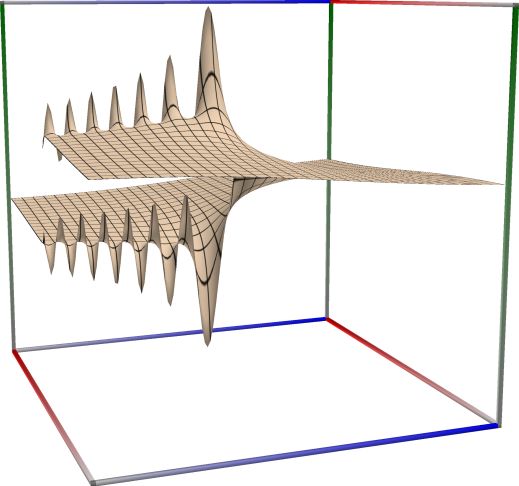
\[\mathrm{Ai}(x) = \frac{1}{3^{2/3}\Gamma(2/3)} {}_0F_1\left(\frac{2}{3},\frac{x^3}{9}\right) - \frac{x}{3^{1/3}\Gamma(1/3)} {}_0F_1\left(\frac{4}{3},\frac{x^3}{9}\right).\]The wpf figures below are showing the real part (left figure), imaginary part (middle figure) and absolute value with color-coded phase (right figure) of the complex function \(z = \mathrm{Ai}(x + iy)\) \(-6 \le x \le 6\) (blue axis), \(-6 \le y \le 6\) (red axis), \(-10 \le z \le 10\) (green axis). Function values are loglog-transformed.
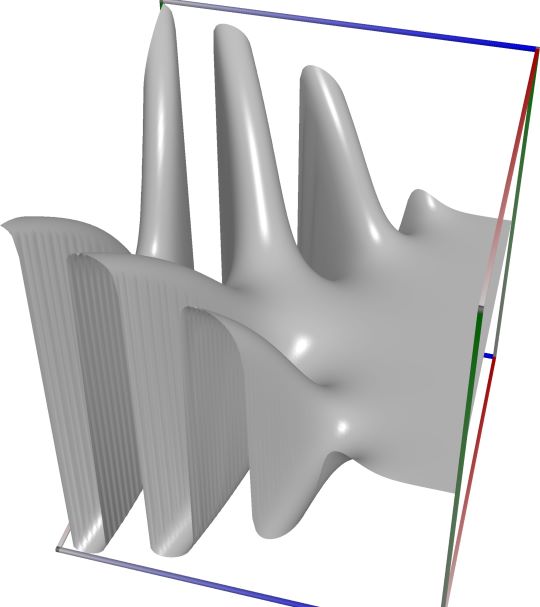 \(\quad\)
 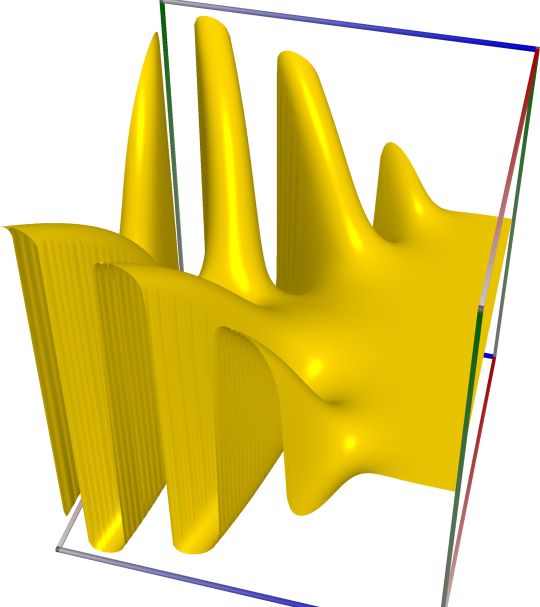 \(\quad\)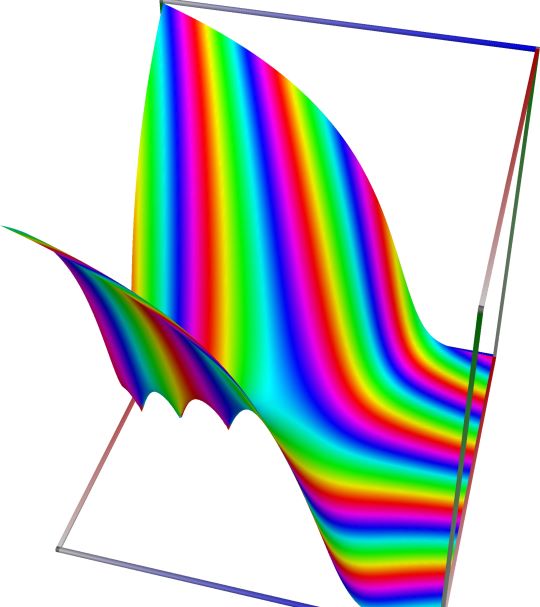
The corresponding scaled function looks like this:
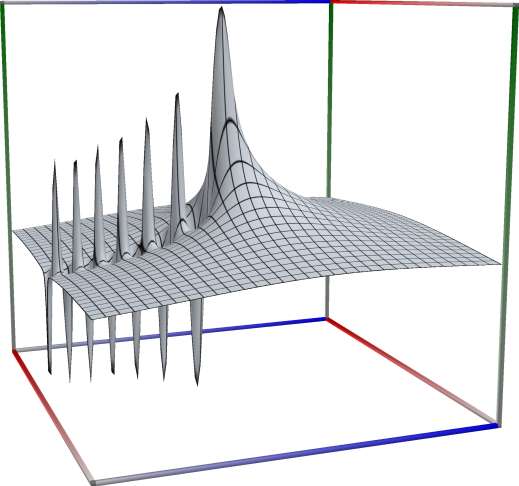 \(\quad\)
  \(\quad\)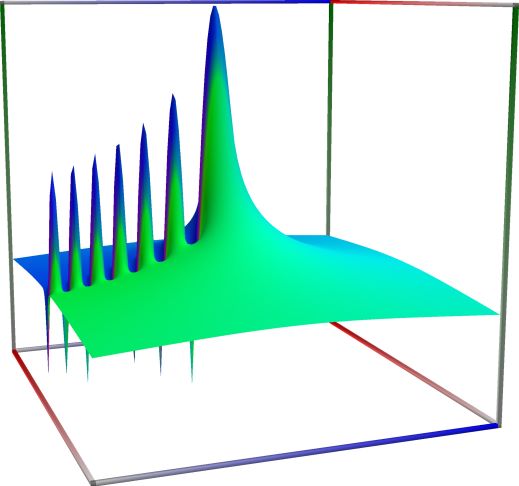
An example in Python
>>> from xlcalcnet import ereal
>>> ereal.AiryAi(0.5)
ereal('5.2359877559829887307E-1')
>>> ereal.AiryAi('0.51')
ereal('5.3518479027559984754E-1')
Airy function \(\mathrm{Bi}(x)\)#
- ctx.airy_bi(x, scaled=False)#
where
ctxismath53,ctxboostorctxflint.Returns the Airy function \(\mathrm{Bi}(x)\), with \(x \in \mathbb{C}\).
If scaled is True, then \(\mathrm{Bi}(x) \exp(-|\Re (\sqrt{x} \cdot 2x/3)|)\) is returned, except for a real
ctxwith \(x \le 0\) where just \(\mathrm{Bi}(x)\) is returned.See also Wikipedia [1297], MathWorld [941], MathWorld [264], NIST [434], BoostMath [113], Ehrhardt [297] (3.1.7.2), Mpmath [624].
The function \(\mathrm{Bi}(x)\) can be defined as
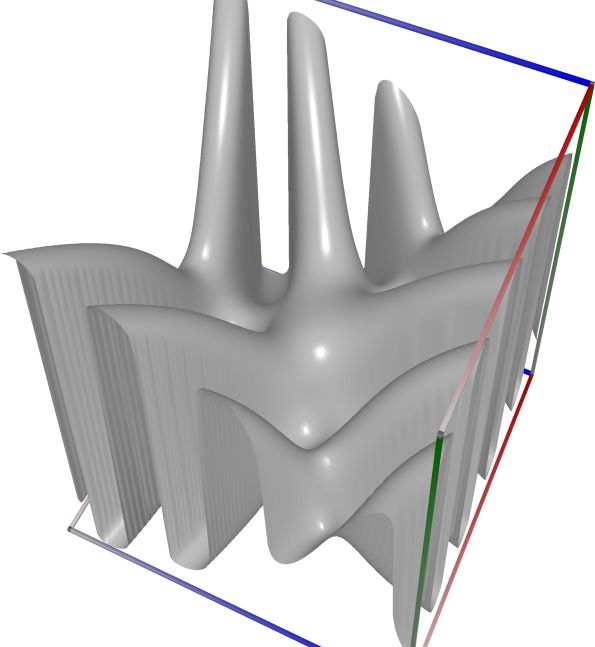
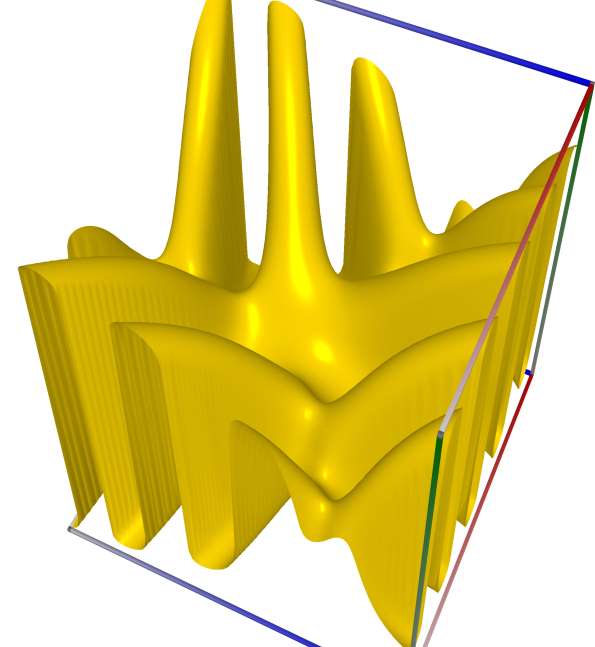
\[\mathrm{Bi}(x) = \frac{1}{3^{1/6}\Gamma(2/3)} {}_0F_1\left(\frac{2}{3},\frac{x^3}{9}\right) + \frac{3^{1/6} x}{\Gamma(1/3)} {}_0F_1\left(\frac{4}{3},\frac{x^3}{9}\right).\]The wpf figures below are showing the real part (left figure), imaginary part (middle figure) and absolute value with color-coded phase (right figure) of the complex function \(z = \mathrm{Bi}(x + iy)\) with \(-6 \le x \le 6\) (blue axis), \(-6 \le y \le 6\) (red axis), \(-10 \le z \le 10\) (green axis). Function values are loglog-transformed.
 \(\quad\)
  \(\quad\)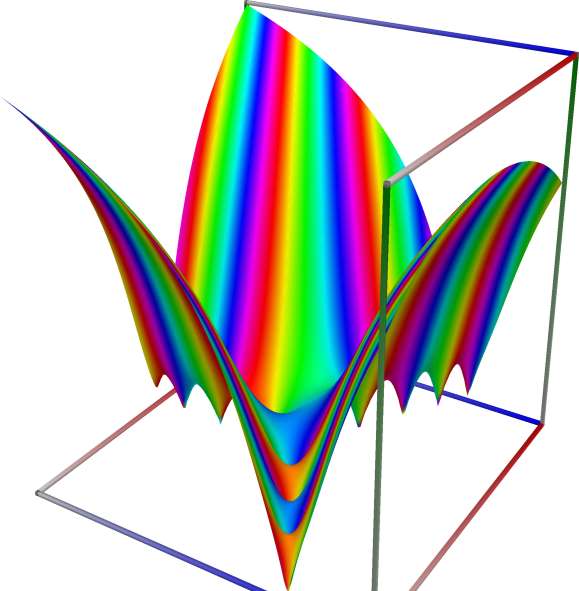
The corresponding scaled function looks like this:
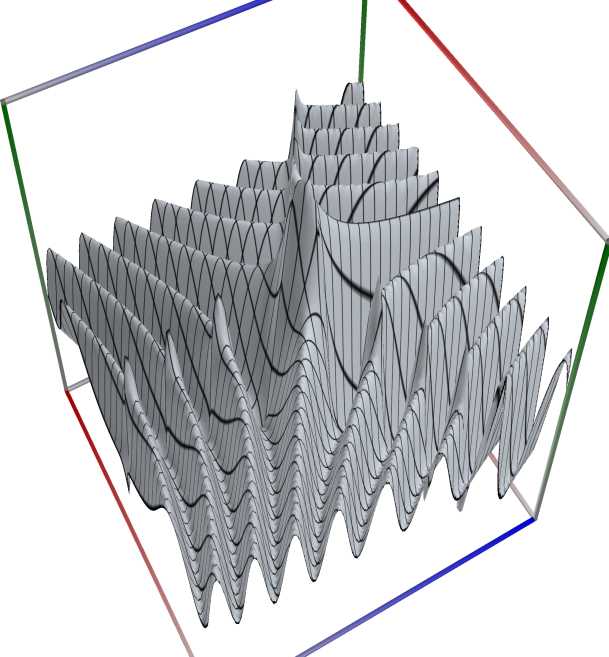 \(\quad\)
 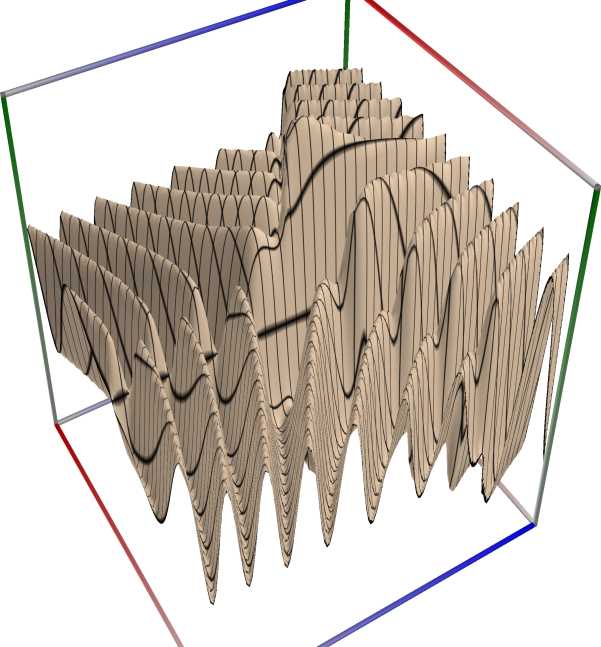 \(\quad\)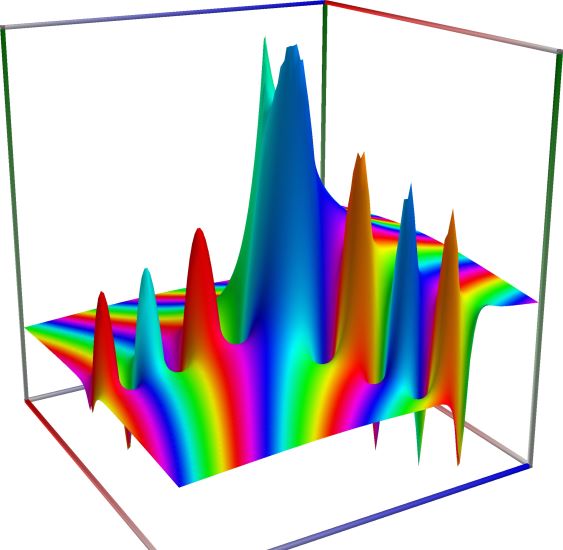
An example in Python
>>> from xlcalcnet import ereal
>>> ereal.AiryBi(0.5)
ereal('5.2359877559829887307E-1')
>>> ereal.AiryBi('0.51')
ereal('5.3518479027559984754E-1')
First derivative of the Airy function \(\mathrm{Ai}\), \(\mathrm{Ai}'(x)\)#
- ctx.airy_ai_prime(x, scaled=False)#
where
ctxismath53,ctxboostorctxflint.Returns \(\mathrm{Ai}'(x)\), the first derivative (with respect to \(x\)) of the Airy function \(\mathrm{Ai}(x)\), with \(x \in \mathbb{C}\).
If scaled is True, then \(\mathrm{Ai}'(x) \exp(\sqrt{x} \cdot 2x/3)\) is returned, except for a real
ctxwith \(x \le 0\) where just \(\mathrm{Ai}'(x)\) is returned.See also Wikipedia [1297], MathWorld [941], MathWorld [263], NIST [434], BoostMath [132], Ehrhardt [297] (3.1.7.3).
The function \(\mathrm{Ai}'(x)\) can be defined as
\[\mathrm{Ai}'(x) = \frac{x^2}{2 \cdot 3^{2/3}\Gamma(2/3)} {}_0F_1\left(\frac{5}{3},\frac{x^3}{9}\right) - \frac{1}{3^{1/3}\Gamma(1/3)} {}_0F_1\left(\frac{1}{3},\frac{x^3}{9}\right).\]The wpf figures below are showing the real part (left figure), imaginary part (middle figure) and absolute value with color-coded phase (right figure) of the complex function \(z = \mathrm{Ai}'(x + iy)\) with \(\nu=0\) and \(-6 \le x \le 6\) (blue axis), \(-6 \le y \le 6\) (red axis), \(-10 \le z \le 10\) (green axis). Function values are loglog-transformed.
An example in Python
>>> from xlcalcnet import ereal
>>> ereal.AiryAiPrime(0.5)
ereal('5.2359877559829887307E-1')
>>> ereal.AiryAiPrime('0.51')
ereal('5.3518479027559984754E-1')
First derivative of the Airy function \(\mathrm{Bi}\), \(\mathrm{Bi}'(x)\)#
- ctx.airy_bi_prime(x, scaled=False)#
where
ctxismath53,ctxboostorctxflint.Returns \(\mathrm{Bi}'(x)\), the first derivative (with respect to \(x\)) of the Airy function \(\mathrm{Bi}(x)\), with \(x \in \mathbb{C}\).
If scaled is True, then \(\mathrm{Bi}'(x) \exp(-|\Re (\sqrt{x} \cdot 2x/3)|)\) is returned, except for a real
ctxwith \(x \le 0\) where just \(\mathrm{Bi}'(x)\) is returned.See also Wikipedia [1297], MathWorld [941], MathWorld [265], NIST [434], BoostMath [133], Ehrhardt [297] (3.1.7.4) and (3.1.7.6).
The function can be defined as
\[\mathrm{Bi}'(x) = \frac{x^2}{2 \cdot 3^{1/6}\Gamma(2/3)} {}_0F_1\left(\frac{5}{3},\frac{x^3}{9}\right) + \frac{3^{1/6}}{\Gamma(1/3)} {}_0F_1\left(\frac{1}{3},\frac{x^3}{9}\right).\]The wpf figures below are showing the real part (left figure), imaginary part (middle figure) and absolute value with color-coded phase (right figure) of the complex function \(z = \mathrm{Bi}'(x + iy)\) with \(\nu=0\) and \(-6 \le x \le 6\) (blue axis), \(-6 \le y \le 6\) (red axis), \(-10 \le z \le 10\) (green axis). Function values are loglog-transformed.
An example in Python
>>> from xlcalcnet import ereal
>>> ereal.AiryAiPrime(0.5)
ereal('5.2359877559829887307E-1')
>>> ereal.AiryAiPrime('0.51')
ereal('5.3518479027559984754E-1')
Real zeros \(a_k\) of the Airy function \(\mathrm{Ai}\), \(\mathrm{Ai}(a_k)=0\)#
- ctx.airy_ai_zero(k)#
where
ctxismath53,ctxboostorctxflint.Returns the \(k\)-th zero of the Airy Ai-function. See also MathWorld [949], NIST [434], BoostMath [113], BoostMath [133], Mpmath [640].
An example in Python
>>> from xlcalcnet import ereal
>>> ereal.AiryAiZero(5)
ereal('5.2359877559829887307E-1')
>>> ereal.AiryAiZero(17)
ereal('5.3518479027559984754E-1')
Real zeros \(b_k\) of the Airy function \(\mathrm{Bi}\), \(\mathrm{Bi}(b_k)=0\)#
- ctx.airy_bi_zero(k)#
where
ctxismath53,ctxboostorctxflint.Returns the \(k\)-th zero of the Airy Bi-function. See also Wikipedia [1297], NIST [434], MathWorld [950], BoostMath [140], Mpmath [641].
An example in Python
>>> from xlcalcnet import ereal
>>> ereal.AiryBiZero(5)
ereal('5.2359877559829887307E-1')
>>> ereal.AiryBiZero(17)
ereal('5.3518479027559984754E-1')