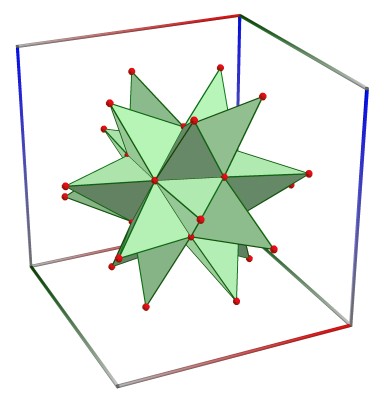
Platonic solids, and related solids#
A Platonic solid is a convex, regular polyhedron in three-dimensional Euclidean space. Being a regular polyhedron means that the faces are congruent (identical in shape and size) regular polygons (all angles congruent and all edges congruent), and the same number of faces meet at each vertex.
See also: https://en.wikipedia.org/wiki/Platonic_solid
See also: https://mathworld.wolfram.com/PlatonicSolid.html
Augmentation is the operation of replacing the faces of a polyhedron with pyramids of height \(h\) (where \(h\) may be positive, zero, or negative) having the face as the base. Augmentation with \(h=0\) gives a triangulated version of the original solid.
See also: https://mathworld.wolfram.com/Augmentation.html
Tetrahedron#
The XML code for the example below can be found online in the DataXlCalcNet repository or in the corresponding local DataXlCalcNet folder in the file D01a_Tetrahedron.3D.xml.
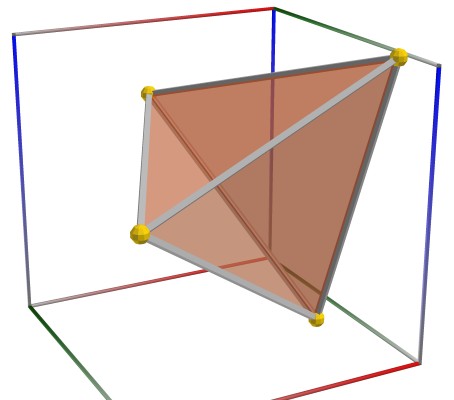
A regular tetrahedron is a tetrahedron in which all four faces are equilateral triangles. In other words, all of its faces are the same size and shape (congruent) and all edges are the same length.
See also: https://en.wikipedia.org/wiki/Tetrahedron#Regular_tetrahedron
See also: https://mathworld.wolfram.com/RegularTetrahedron.html
See also: https://mathcurve.com/polyedres/tetraedre/tetraedre.shtml
The example below uses the following code in C#
var proc = BuiltIn.SetTetrahedron();
Cube#
The XML code for the example below can be found online in the DataXlCalcNet repository or in the corresponding local DataXlCalcNet folder in the file D02a_Cube.3D.xml.
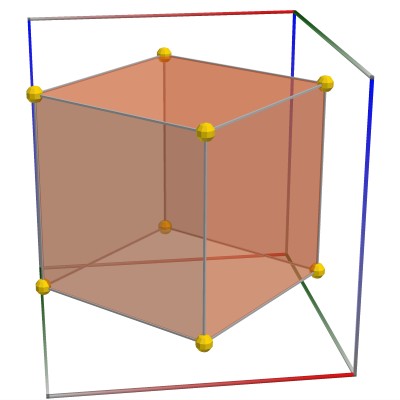
A cube is a three-dimensional solid object bounded by six square faces. It has twelve edges and eight vertices. It can be represented as a rectangular cuboid with six square faces, or a parallelepiped with equal edges.
See also: https://en.wikipedia.org/wiki/Cube
See also: https://mathworld.wolfram.com/Cube.html
See also: https://mathcurve.com/polyedres/cube/cube.shtml
The example below uses the following code in C#
var proc = BuiltIn.SetCube();
Octahedron#
The XML code for the example below can be found online in the DataXlCalcNet repository or in the corresponding local DataXlCalcNet folder in the file D03a_Octahedron.3D.xml.
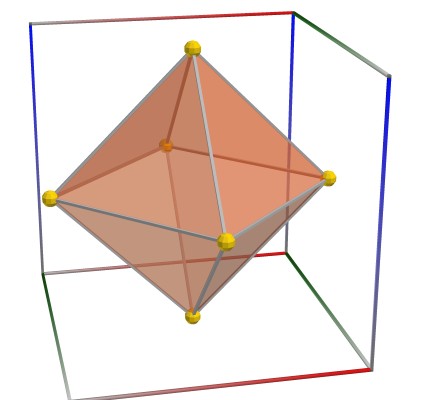
A regular octahedron is an octahedron that is a regular polyhedron. All the faces of a regular octahedron are equilateral triangles of the same size, and exactly four triangles meet at each vertex. A regular octahedron is convex, meaning that for any two points within it, the line segment connecting them lies entirely within it.
See also: https://en.wikipedia.org/wiki/Octahedron#Regular_octahedron
See also: https://mathworld.wolfram.com/RegularOctahedron.html
See also: https://mathcurve.com/polyedres/octaedre/octaedre.shtml
The example below uses the following code in C#
var proc = BuiltIn.SetOctahedron();
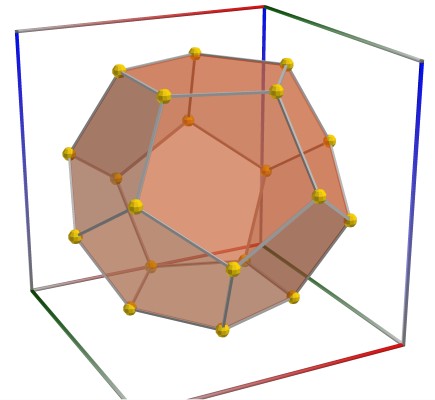
Dodecahedron#
The XML code for the example below can be found online in the DataXlCalcNet repository or in the corresponding local DataXlCalcNet folder in the file D04a_Dodecahedron.3D.xml.
A regular dodecahedron or pentagonal dodecahedron is a dodecahedron composed of regular pentagonal faces, three meeting at each vertex.
See also: https://en.wikipedia.org/wiki/Regular_dodecahedron
See also: https://mathworld.wolfram.com/RegularDodecahedron.html
See also: https://mathcurve.com/polyedres/dodecaedre/dodecaedre.shtml
The example below uses the following code in C#
var proc = BuiltIn.SetDodecahedron();
Icosahedron#
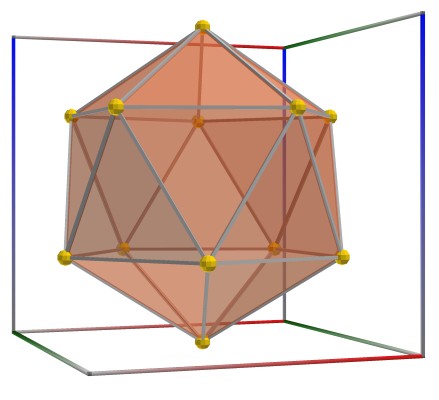
The XML code for the example below can be found online in the DataXlCalcNet repository or in the corresponding local DataXlCalcNet folder in the file D05a_Icosahedron.3D.xml.
A regular icosahedron (or simply icosahedron) is a convex polyhedron that can be constructed from pentagonal antiprism by attaching two pentagonal pyramids with regular faces to each of its pentagonal faces, or by putting points onto the cube.
See also: https://en.wikipedia.org/wiki/Regular_icosahedron
See also: https://mathworld.wolfram.com/RegularIcosahedron.html
See also: https://mathcurve.com/polyedres/icosaedre/icosaedre.shtml
The example below uses the following code in C#
var proc = BuiltIn.SetIcosahedron();
Geodesic sphere#
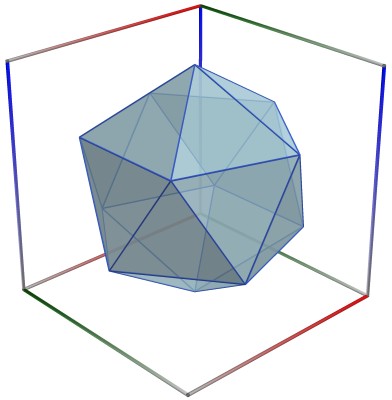
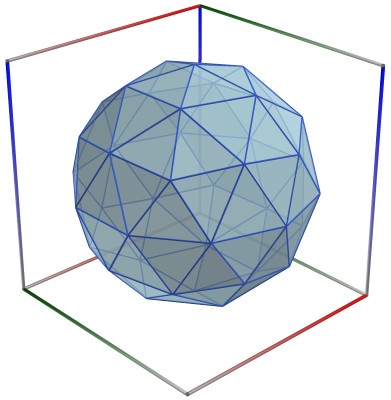
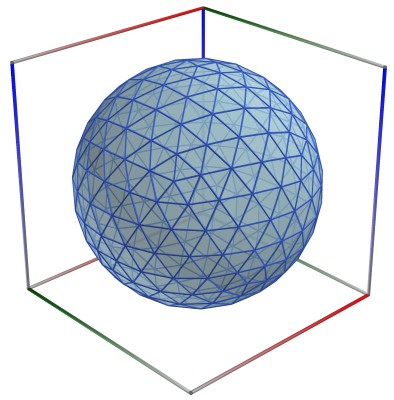
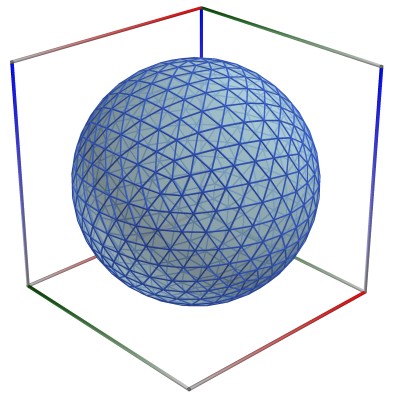
The XML code for the example below can be found online in the DataXlCalcNet repository or in the corresponding local DataXlCalcNet folder in the file D06a_Geodesic_Sphere1.3D.xml (D06a-f).
A spherical polyhedron or spherical tiling is a tiling of the sphere in which the surface is divided or partitioned by great arcs into bounded regions called spherical polygons
See also: https://en.wikipedia.org/wiki/Geodesic_polyhedron
See also: https://en.wikipedia.org/wiki/Spherical_polyhedron
The example below uses the following code in C#
var radius = 1.0;
var numDiv = 1;
var proc = BuiltIn.SetGeodesicSphere(radius, numDiv);
 \(\quad\)
  \(\quad\)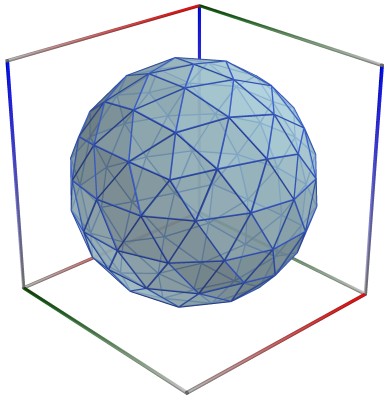
 \(\quad\)
  \(\quad\)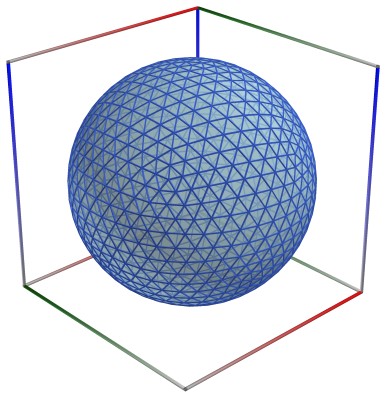
Augmented Octahedron#
The XML code for the example below can be found online in the DataXlCalcNet repository or in the corresponding local DataXlCalcNet folder in the file D07a_Augm_Octahedron_a.3D.xml (D07a-c).
Returns the augmented Octahedron.
The example below uses the following code in C#
var starRadius = 3.0;
var proc = BuiltIn.SetAugmentedOctahedron(starRadius );
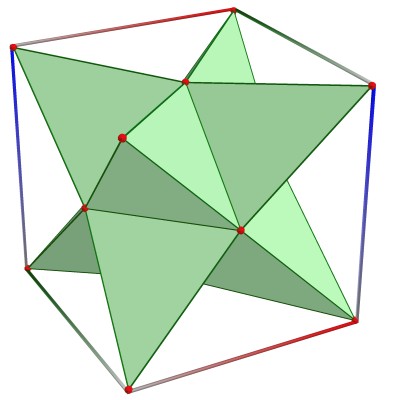 \(\quad\)
 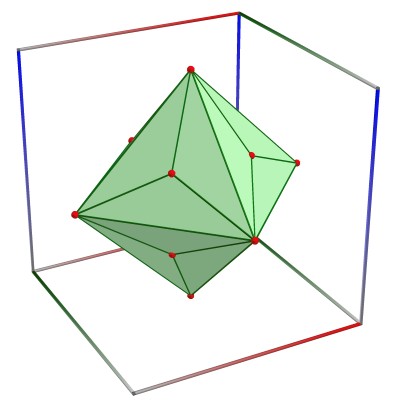 \(\quad\)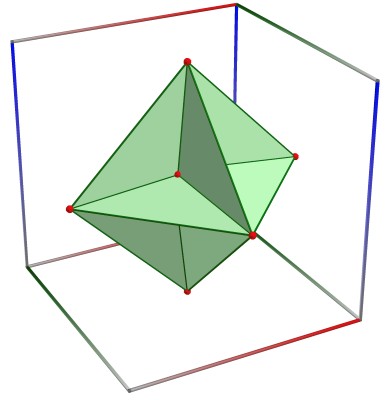
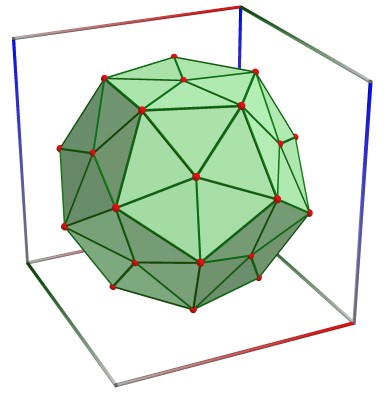
Augmented Dodecahedron#
The XML code for the example below can be found online in the DataXlCalcNet repository or in the corresponding local DataXlCalcNet folder in the file D08a_Augm_Dodecahedron_a.3D.xml (D08a-c).
Returns the augmented Dodecahedron.
The example below uses the following code in C#
var starRadius = 6.0;
var proc = BuiltIn.SetAugmentedDodecahedron(starRadius );
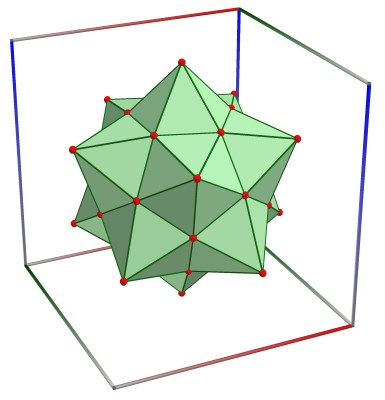 \(\quad\)
  \(\quad\)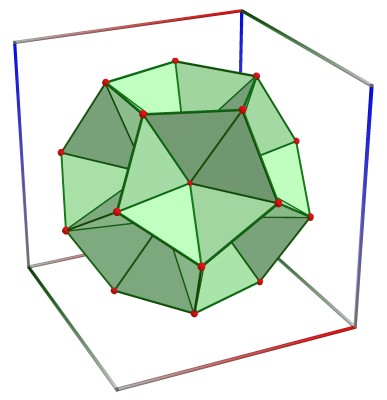
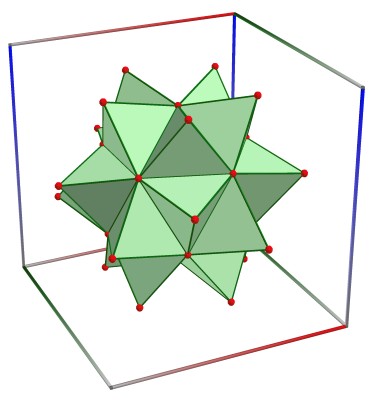
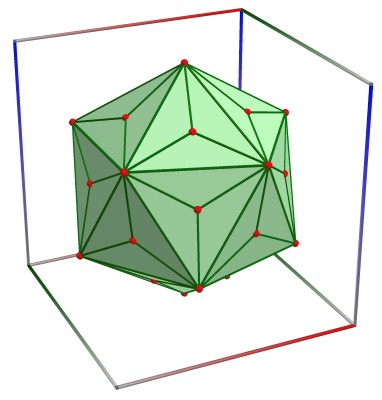
Augmented Icosahedron#
The XML code for the example below can be found online in the DataXlCalcNet repository or in the corresponding local DataXlCalcNet folder in the file D09a_Augm_Icosahedron_a.3D.xml (D09a-c).
Returns the augmented Dodecahedron.
The example below uses the following code in C#
var starRadius = 2.0;
var proc = BuiltIn.SetAugmentedIcosahedron(starRadius );
 \(\quad\)
  \(\quad\)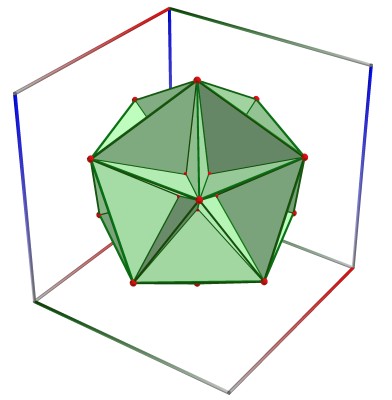
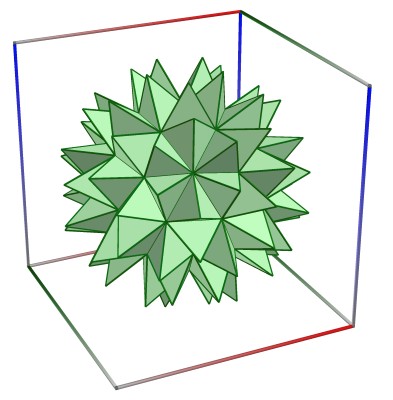
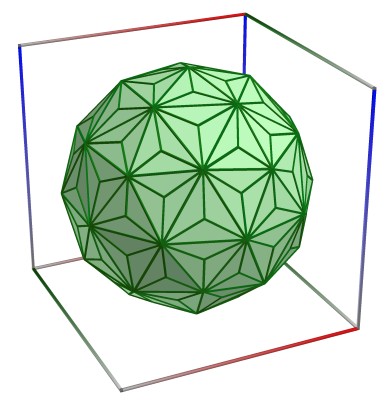
Augmented Geodesic Sphere#
The XML code for the example below can be found online in the DataXlCalcNet repository or in the corresponding local DataXlCalcNet folder in the file D10a_Augm_Geodesic_a.3D.xml (D10a-c).
Returns augmented versions of the Geodesic.
See also: https://mathworld.wolfram.com/IcosahedronStellations.html
The example below uses the following code in C#
var starRadius = 2.0;
var numDiv = 2;
var proc = BuiltIn.SetAugmentedGeodesic(starRadius, numDiv);
 \(\quad\)
  \(\quad\)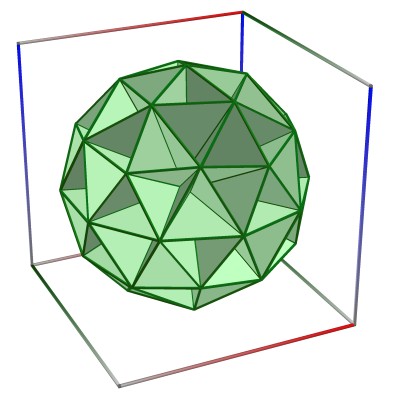
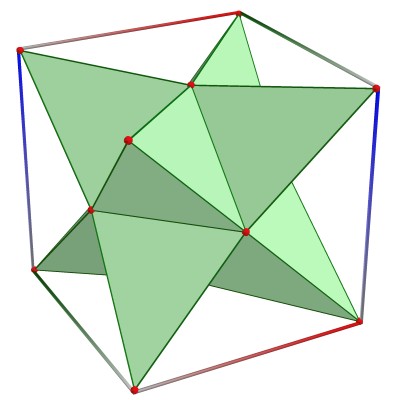
Stella Octangula#
The XML code for the example below can be found online in the DataXlCalcNet repository or in the corresponding local DataXlCalcNet folder in the file D11a_StellaOctangula.3D.xml (D10a-c).
The stella octangula is a polyhedron compound composed of a tetrahedron and its dual (a second tetrahedron rotated 180 degrees with respect to the first). The stella octangula is also (incorrectly) called the augmented tetrahedron, and is the only stellation of the octahedron.
It can be constructed from a regular octahedron by augmentation with \(h = \sqrt{6}/3\).
See also: https://mathworld.wolfram.com/StellaOctangula.html
See also: https://en.wikipedia.org/wiki/Stellated_octahedron
The example below uses the following code in C#
var starRadius = 2.0;
var proc = BuiltIn.SetAugmentedOctahedron(starRadius );
Small stellated Dodecahedron#
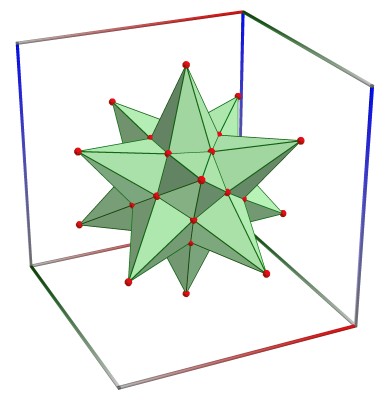
The XML code for the example below can be found online in the DataXlCalcNet repository or in the corresponding local DataXlCalcNet folder in the file D12a_SmallStellatedDodecahedron.3D.xml (D10a-c).
The small stellated dodecahedron is the Kepler-Poinsot polyhedra whose dual polyhedron is the great dodecahedron.
It can be constructed from a regular dodecahedron by augmentation with \(h = \sqrt{(5 + 2\sqrt{5})/5 }\).
See also: https://mathworld.wolfram.com/SmallStellatedDodecahedron.html
See also: https://mathworld.wolfram.com/Augmentation.html
See also: https://en.wikipedia.org/wiki/Small_stellated_dodecahedron
See also: https://mathworld.wolfram.com/Kepler-PoinsotPolyhedron.html
The example below uses the following code in C#
var starRadius = 6.0;
var proc = BuiltIn.SetAugmentedDodecahedron(starRadius );
Great Dodecahedron#
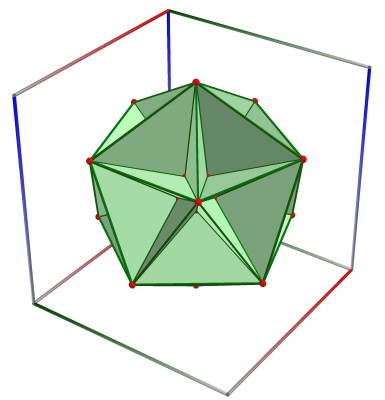
The XML code for the example below can be found online in the DataXlCalcNet repository or in the corresponding local DataXlCalcNet folder in the file D13a_GreatDodecahedron.3D.xml (D10a-c).
The great dodecahedron is the Kepler-Poinsot polyhedron whose dual is the small augmented dodecahedron.
It can be constructed from a regular icosahedron by augmentation with \(h = (\sqrt{3} (\sqrt{5}-3))/6\).
See also: https://mathworld.wolfram.com/GreatDodecahedron.html
See also: https://mathworld.wolfram.com/Augmentation.html
See also: https://en.wikipedia.org/wiki/Great_dodecahedron
See also: https://mathworld.wolfram.com/Kepler-PoinsotPolyhedron.html
The example below uses the following code in C#
var starRadius = 0.25;
var proc = BuiltIn.SetAugmentedIcosahedron(starRadius );
Great stellated Dodecahedron#
The XML code for the example below can be found online in the DataXlCalcNet repository or in the corresponding local DataXlCalcNet folder in the file D14a_GreatStellatedDodecahedron.3D.xml (D10a-c).
The great augmented dodecahedron is one of the Kepler-Poinsot polyhedra.
It can be constructed from a regular icosahedron by augmentation with \(h = (\sqrt{3} (3+\sqrt{5}))/6\).
See also: https://mathworld.wolfram.com/GreatStellatedDodecahedron.html
See also: https://mathworld.wolfram.com/Augmentation.html
See also: https://en.wikipedia.org/wiki/Great_stellated_dodecahedron
See also: https://mathworld.wolfram.com/Kepler-PoinsotPolyhedron.html
The example below uses the following code in C#
var starRadius = 2.0;
var proc = BuiltIn.SetAugmentedIcosahedron(starRadius );