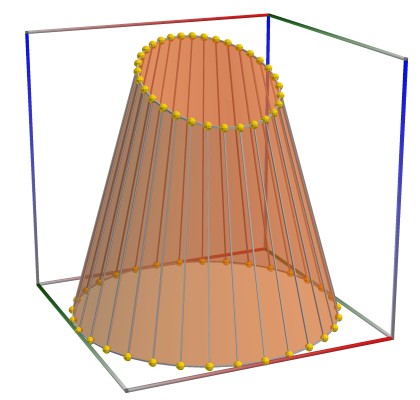
Builtin solids without support for textures#
See also: https://mathworld.wolfram.com/topics/Prisms.html
See also: https://en.wikipedia.org/wiki/Prism_(geometry)
A prism is a polyhedron comprising an n-sided polygon base, a second base which is a translated copy (rigidly moved without rotation) of the first, and n other faces, necessarily all parallelograms, joining corresponding sides of the two bases. All cross-sections parallel to the bases are translations of the bases. Prisms are named after their bases, e.g. a prism with a pentagonal base is called a pentagonal prism.
Triangular Prism#
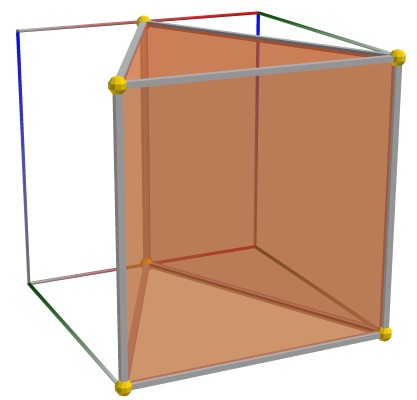
The XML code for the example below can be found online in the DataXlCalcNet repository or in the corresponding local DataXlCalcNet folder in the files D01a_TriangularPrism.3D.xml (D01a-b).
A triangular prism or trigonal prism[1] is a prism with 2 triangular bases. If the edges pair with each triangle’s vertex and if they are perpendicular to the base, it is a right triangular prism.
See also: https://mathworld.wolfram.com/TriangularPrism.html
See also: https://en.wikipedia.org/wiki/Triangular_prism
The example below uses the following code in C#
var a = 0.50;
var b = 0.50;
var height = 1.0;
var proc = BuiltIn.SetTriangularPrism(a, b, height, 0,0);
 \(\quad\)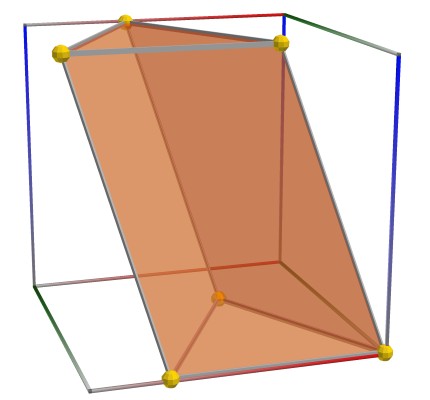
Square prism#
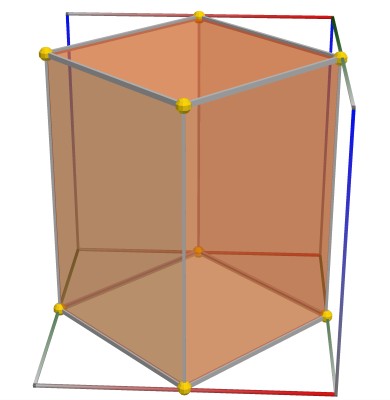
The XML code for the example below can be found online in the DataXlCalcNet repository or in the corresponding local DataXlCalcNet folder in the files D02a_SquarePrism.3D.xml (D02a-b).
See also: https://mathworld.wolfram.com/Cube.html
See also: https://en.wikipedia.org/wiki/Cuboid
Cuboids have different types. A special case of a cuboid is a rectangular cuboid, with six rectangle faces and adjacent faces meeting at right angles. When all of the rectangular cuboid’s edges are equal in length, it results in a cube, with six square faces and adjacent faces meeting at right angles.[1][3] Along with the rectangular cuboids, parallelepiped is a cuboid with six parallelogram. Rhombohedron is a cuboid with six rhombus faces. A square frustum is a frustum with a square base, but the rest of its faces are quadrilaterals.
The example below uses the following code in C#
var a = 0.50;
var b = 0.50;
var height = 0.55;
var proc = BuiltIn.SetSquarePrism(a, b, height, 0,0);
 \(\quad\)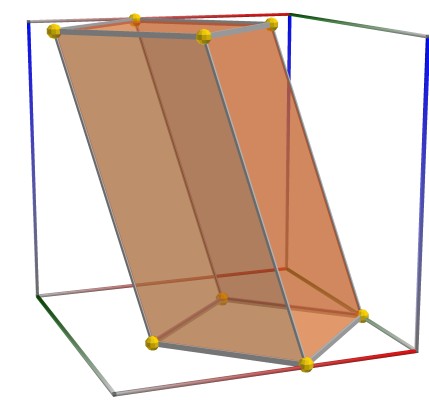
Hexagonal prism#
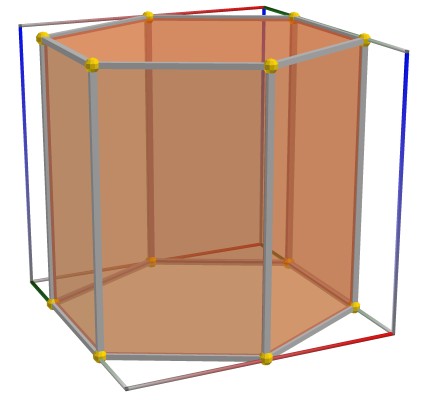
The XML code for the example below can be found online in the DataXlCalcNet repository or in the corresponding local DataXlCalcNet folder in the files D03a_HexagonalPrism.3D.xml (D03a-b).
The hexagonal prism is a prism with hexagonal base. Prisms are polyhedrons; this polyhedron has 8 faces, 18 edges, and 12 vertices.
See also: https://mathworld.wolfram.com/HexagonalPrism.html
See also: https://en.wikipedia.org/wiki/Hexagonal_prism
The example below uses the following code in C#
var a = 0.50;
var b = 0.50;
var height = 1.0;
var proc = BuiltIn.SetHexagonalPrism(a, b, height, 0,0);
 \(\quad\)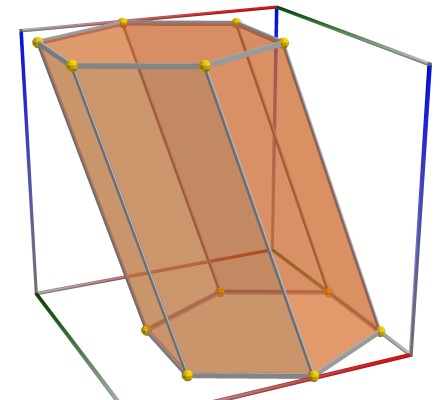
Octagonal prism#
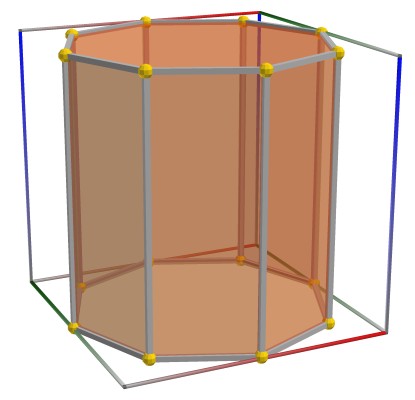
The XML code for the example below can be found online in the DataXlCalcNet repository or in the corresponding local DataXlCalcNet folder in the files D04a_OctagonalPrism.3D.xml (D04a-b).
The octagonal prism is a prism comprising eight rectangular sides joining two regular octagon caps.
See also: https://mathworld.wolfram.com/OctagonalPrism.html
See also: https://en.wikipedia.org/wiki/Octagonal_prism
The example below uses the following code in C#
var a = 0.50;
var b = 0.50;
var height = 1.0;
var proc = BuiltIn.SetOctagonalPrism(a, b, height, 0,0);
 \(\quad\)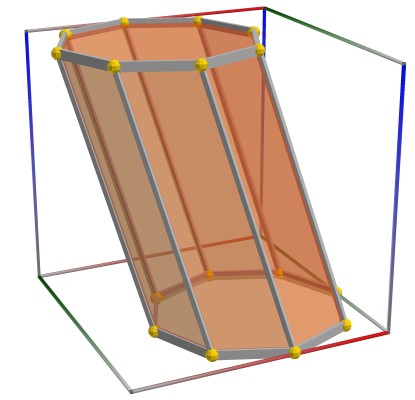
Cylinder#
The XML code for the example below can be found online in the DataXlCalcNet repository or in the corresponding local DataXlCalcNet folder in the file D05a_Cylinder.3D.xml.
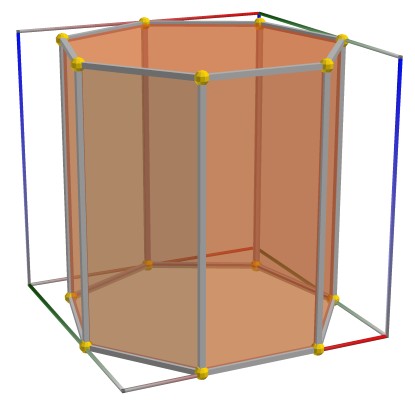
A cylinder is considered a prism with a circle as its base. The cylinder obtained by rotating a line segment about a fixed line that it is parallel to is a cylinder of revolution. A cylinder of revolution is a right circular cylinder.
See also: https://en.wikipedia.org/wiki/Cylinder
See also: https://en.wikipedia.org/wiki/Right_circular_cylinder
See also: https://mathworld.wolfram.com/Cylinder.html
The example below uses the following code in C#
var numSides = 7;
var a = 0.50;
var b = 0.50;
var height = 1.0;
var proc = BuiltIn.SetCylinder(numSides, a, b, height, 0,0);
Cylinder, truncated by an inclined plane#
The XML code for the example below can be found online in the DataXlCalcNet repository or in the corresponding local DataXlCalcNet folder in the files D06a_Cylinder_Tilted.3D.xml (D06a-b).
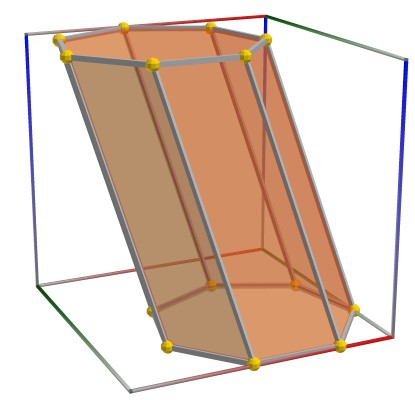
A cylinder is considered a prism with a circle as its base. The cylinder obtained by rotating a line segment about a fixed line that it is parallel to is a cylinder of revolution. A cylinder of revolution is a right circular cylinder.
See also: https://en.wikipedia.org/wiki/Cylinder
See also: https://en.wikipedia.org/wiki/Right_circular_cylinder
See also: https://mathworld.wolfram.com/Cylinder.html
The example below uses the following code in C#
var numSides = 7;
var a = 0.50;
var b = 0.50;
var height = 1.0;
var cutslope1 = -0.5;
var cutslope2 = 0.5;
var proc = BuiltIn.SetCylinder2CP(numSides, a, b, height, cutslope1, cutslope2);
 \(\quad\)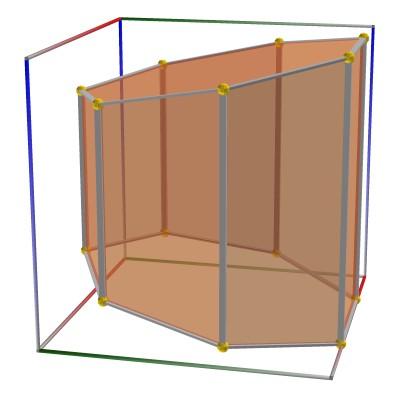
Pyramid#
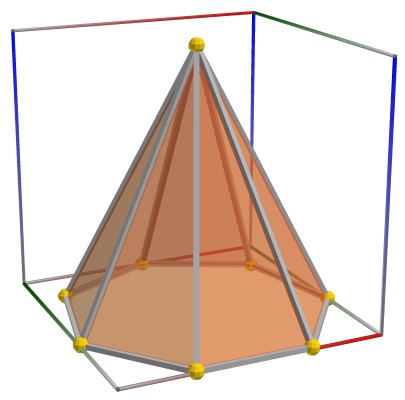
The XML code for the example below can be found online in the DataXlCalcNet repository or in the corresponding local DataXlCalcNet folder in the file D07a_Pyramid.3D.xml.
A pyramid is a polyhedron formed by connecting a polygonal base and a point, called the apex. Each base edge and apex form a triangle, called a lateral face. It is a conic solid with a polygonal base. Many types of pyramids can be found by determining the shape of bases, or cutting off the apex.
See also: https://en.wikipedia.org/wiki/Pyramid_(geometry)
See also: https://mathworld.wolfram.com/Pyramid.html
The example below uses the following code in C#
var numSides = 7;
var a = 0.50;
var b = 0.50;
var height = 1.0;
var proc = BuiltIn.SetPyramid(numSides, a, b, height);
Pyramid frustum#
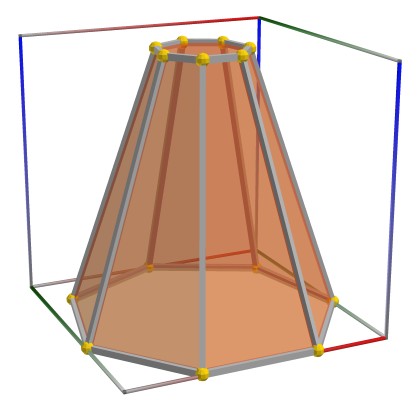
The XML code for the example below can be found online in the DataXlCalcNet repository or in the corresponding local DataXlCalcNet folder in the file D08a_Frustum.3D.xml.
A frustum of a pyramid is the portion of the pyramid that lies between two parallel planes cutting the pyramid. In a truncated pyramid, the truncation plane is not necessarily parallel to the pyramid’s base (as in a frustum), i.e. it is inclined.
See also: https://en.wikipedia.org/wiki/Frustum
See also: https://mathworld.wolfram.com/PyramidalFrustum.html
The example below uses the following code in C#
var numSides = 7;
var a = 0.50;
var b = 0.50;
var height = 1.2;
var cutheight = 0.8;
var cutslope = 0.0;
var proc = BuiltIn.SetFrustum(numSides, a, b, height, cutheight, cutslope);
Pyramid, truncated by an inclined plane#
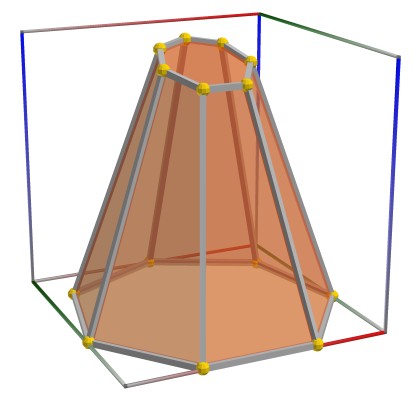
The XML code for the example below can be found online in the DataXlCalcNet repository or in the corresponding local DataXlCalcNet folder in the file D09a_Frustum_Inclined.3D.xml.
A frustum of a pyramid is the portion of the pyramid that lies between two parallel planes cutting the pyramid. In a truncated pyramid, the truncation plane is not necessarily parallel to the pyramid’s base (as in a frustum), i.e. it is inclined.
See also: https://en.wikipedia.org/wiki/Frustum
See also: https://mathworld.wolfram.com/PyramidalFrustum.html
The example below uses the following code in C#
var numSides = 7;
var a = 0.50;
var b = 0.50;
var height = 1.2;
var cutheight = 0.8;
var cutslope = 0.3;
var proc = BuiltIn.SetFrustum(numSides, a, b, height, cutheight, cutslope);
Cone#
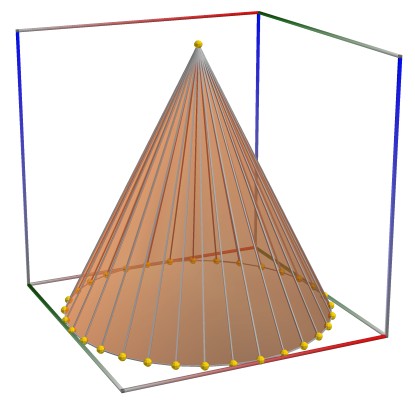
The XML code for the example below can be found online in the DataXlCalcNet repository or in the corresponding local DataXlCalcNet folder in the file D10a_Cone.3D.xml.
A cone is a three-dimensional geometric shape that tapers smoothly from a flat base (frequently, though not necessarily, circular) to a point called the apex or vertex. A cone with a polygonal base is called a pyramid.
See also: https://en.wikipedia.org/wiki/Cone
See also: https://mathworld.wolfram.com/Cone.html
The example below uses the following code in C#
var numSides = 32;
var a = 0.50;
var b = 0.50;
var height = 1.0;
var proc = BuiltIn.SetCone(numSides, a, b, height);
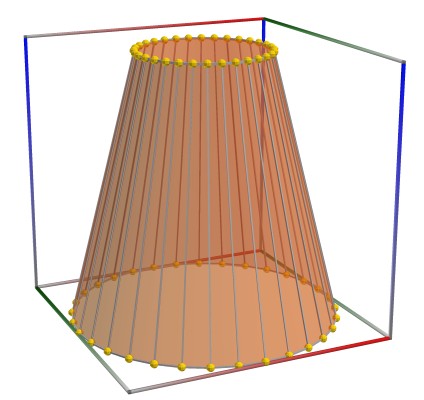
Cone Frustum#
The XML code for the example below can be found online in the DataXlCalcNet repository or in the corresponding local DataXlCalcNet folder in the file D11a_ConeFrustum.3D.xml.
A cone is a three-dimensional geometric shape that tapers smoothly from a flat base (frequently, though not necessarily, circular) to a point called the apex or vertex. A cone with a polygonal base is called a pyramid.
See also: https://en.wikipedia.org/wiki/Frustum
See also: https://mathworld.wolfram.com/ConicalFrustum.html
The example below uses the following code in C#
var numSides = 32;
var a = 0.50;
var b = 0.50;
var height = 1.2;
var cutheight = 0.6;
var cutslope = 0.0;
var proc = BuiltIn.SetConeFrustum(numSides, a, b, height, cutheight, cutslope);
Cone, truncated by an inclined plane#
The XML code for the example below can be found online in the DataXlCalcNet repository or in the corresponding local DataXlCalcNet folder in the file D12a_ConeFrustum_Inclined.3D.xml.
A cone is a three-dimensional geometric shape that tapers smoothly from a flat base (frequently, though not necessarily, circular) to a point called the apex or vertex. A cone with a polygonal base is called a pyramid.
See also: https://en.wikipedia.org/wiki/Frustum
See also: https://mathworld.wolfram.com/ConicalFrustum.html
The example below uses the following code in C#
var numSides = 32;
var a = 0.50;
var b = 0.50;
var height = 1.2;
var cutheight = 0.6;
var cutslope = 0.3;
var proc = BuiltIn.SetConeFrustum(numSides, a, b, height, cutheight, cutslope);