Legendre elliptic integrals (elliptic modulus \(k\)), and related functions#
For an overview see NIST [178], BoostMath [141], Mpmath [679].
Legendre complete elliptic integral of the first kind, \(K(k)\)#
- ctx.elliptic_k(k)#
where
ctxismath53,mathc53,ctxboostorctxflint.Returns the Legendre complete elliptic integral of the first kind, \(\displaystyle K(k) = \int_0^{\pi/2} \frac{\mathrm{d}t}{\sqrt{1-k^2 \sin^2(t)}}\). See also Wikipedia [1406], MathWorld [1025], NIST [178], BoostMath [143], Ehrhardt [309] (3.2.1.2), Ehrhardt [309] (4.2.30), Flint [815].
 \(\quad\)
  \(\quad\)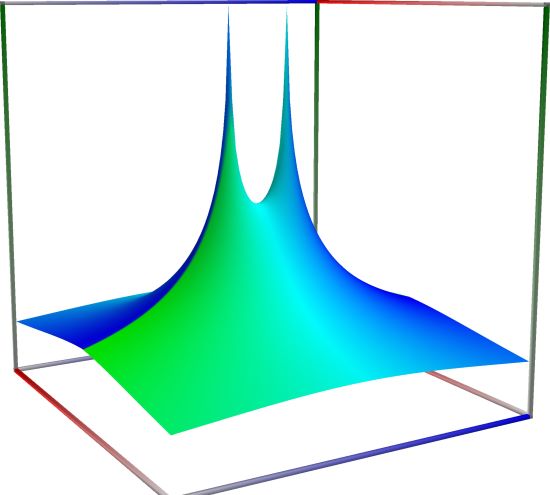
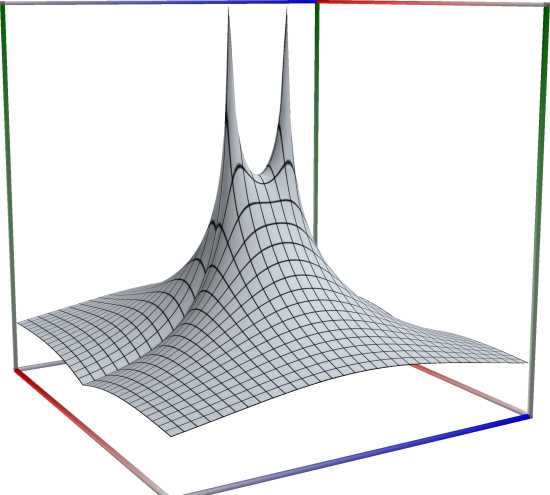
Left figure: real part of the Legendre complete elliptic integral of the first kind, \(K(k)\). Camera angles are \(\theta=135^\circ\) and \(\phi = -12^\circ\), camera radius is -2.
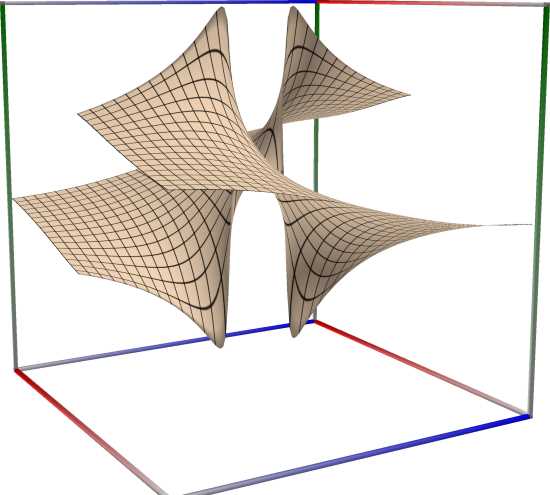
Middle figure: imaginary part of the Legendre complete elliptic integral of the first kind, \(K(k)\). Camera angles are \(\theta=135^\circ\) and \(\phi = -12^\circ\), camera radius is -2.
Right figure: absolute value of the Legendre complete elliptic integral of the first kind, \(K(k)\), with color-coded phase. Camera angles are \(\theta=135^\circ\) and \(\phi = -12^\circ\), camera radius is -2.
Note: the original names are: math53.compEllint1(k), ctxboost.Ellint_1_K(k), mathc53.Ellk(k), ctx.ellipticK(k).
An example in Python
>>> from xlcalcnet import xreal
>>> xreal.CompEllint1(0.5)
xreal('5.2359877559829887307E-1')
>>> xreal.CompEllint1('0.51')
xreal('5.3518479027559984754E-1')
An example in Visual Basic
>>> from xlcalcnet import Gpr
>>> Gpr.CompEllint1(0.5)
Gpr('5.2359877559829887307E-1')
>>> Gpr.CompEllint1('0.51')
Gpr('5.3518479027559984754E-1')
An example with real input:
>>> from xlcalcnet import dec, mpm, gmp, fpm, apm
>>> mpm.dps = 40; m = '0.7'
>>> \mathrm{d}x = dec.elliptic_k(m); mx = mpm.elliptic_k(m); gx = gmp.elliptic_k(m)
>>> fx = fpm.elliptic_k(m); ax = apm.elliptic_k(m)
>>> mpm.show([\mathrm{d}x, mx, gx, fx, ax])
dec:  2.075363135292469143853440555882415805738E+0
mpm:  2.075363135292469143853440555882415805738e+0
gmp:  2.075363135292469143853440555882415805738E+00
fpm:  2.07536313529247E+00
apm:  2.075363135292469143853440555882415805738e+0 (5.531e-39%)
An example with complex input:
>>> from xlcalcnet import dec, mpm, gmp, fpm, apm
>>> mpm.dps = 20; m = '11.0 + 3.0j'
>>> \mathrm{d}z = dec.elliptic_k(m); mz = mpm.elliptic_k(m); gz = gmp.elliptic_k(m)
>>> fz = fpm.elliptic_k(m); az = apm.elliptic_k(m)
>>> mpm.show([\mathrm{d}z, mz, gz, fz, az], aligned=True)
dec: 5.3766585026572650659E-1              + 7.1363115405781075467E-1j
mpm: 5.3766585026572650659e-1              + 7.1363115405781075467e-1j
gmp: 5.3766585026572650659E-01             + 7.1363115405781075467E-01j
fpm: 5.37665850265727E-01                  + 7.13631154057811E-01j
apm: 5.3766585026572650659e-1 (1.575e-19%) + 7.1363115405781075467e-1 (1.187e-19%)j
Legendre complete elliptic integral of the second kind, \(E(k)\)#
- ctx.elliptic_e(k)#
where
ctxismath53,mathc53,ctxboostorctxflint.Note: the original names are: math53.compEllint2(k), ctxboost.Ellint_2_K(k), mathc53.Elle(k), ctx.ellipticE(k).
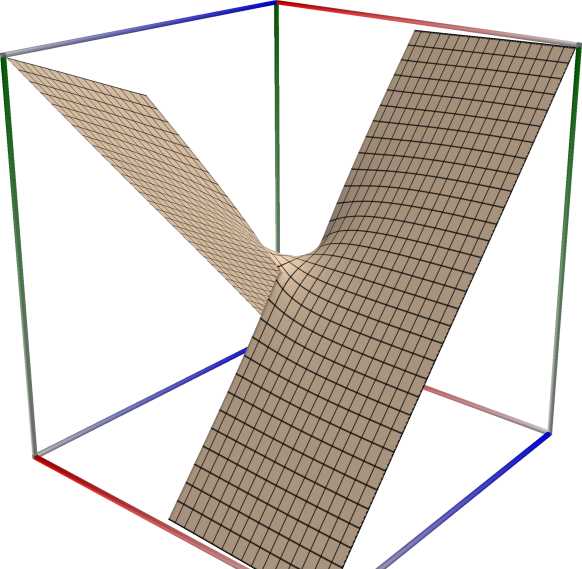
Returns the Legendre complete elliptic integral of the second kind, \(\displaystyle E(k) = \int_0^{\pi/2} \sqrt{1-k^2 \sin^2(t)} \, \mathrm{d}t\). See also Wikipedia [1407], MathWorld [1026], NIST [178], BoostMath [144], Ehrhardt [309] (3.2.1.2), Ehrhardt [309] (4.2.29), Flint [815].
 \(\quad\)
  \(\quad\)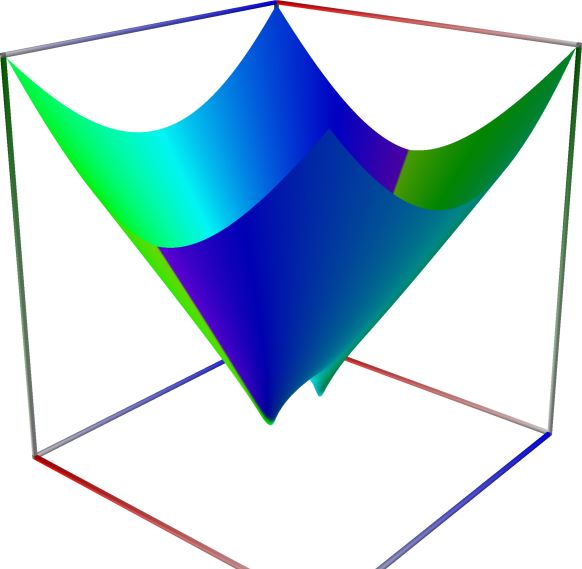
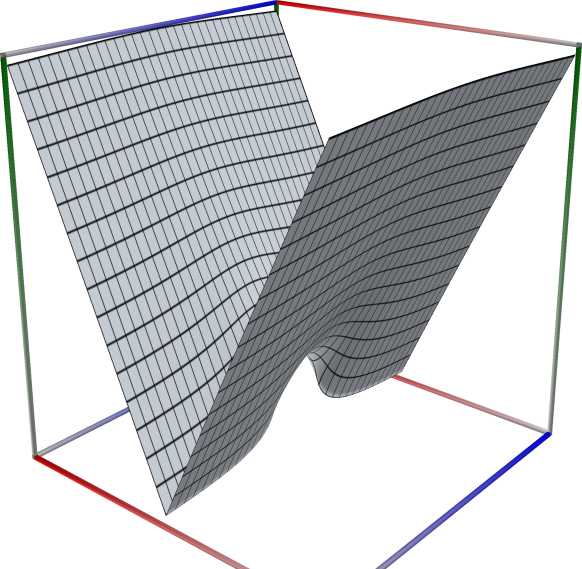
Left figure: real part of the Legendre complete elliptic integral of the second kind, \(E(k)\). Camera angles are \(\theta=135^\circ\) and \(\phi = -12^\circ\), camera radius is -2.
Middle figure: imaginary part of the Legendre complete elliptic integral of the second kind, \(E(k)\). Camera angles are \(\theta=135^\circ\) and \(\phi = -12^\circ\), camera radius is -2.
Right figure: absolute value of the Legendre complete elliptic integral of the second kind, \(E(k)\), with color-coded phase. Camera angles are \(\theta=135^\circ\) and \(\phi = -12^\circ\), camera radius is -2.
An example in Python
>>> from xlcalcnet import xreal
>>> xreal.CompEllint2(0.5)
xreal('5.2359877559829887307E-1')
>>> xreal.CompEllint2('0.51')
xreal('5.3518479027559984754E-1')
An example in Visual Basic
>>> from xlcalcnet import Gpr
>>> Gpr.CompEllint2(0.5)
Gpr('5.2359877559829887307E-1')
>>> Gpr.CompEllint2('0.51')
Gpr('5.3518479027559984754E-1')
An example with real input:
>>> from xlcalcnet import dec, mpm, gmp, fpm, apm
>>> mpm.dps = 40; m = '0.7'
>>> \mathrm{d}x = dec.elliptic_e(m); mx = mpm.elliptic_e(m); gx = gmp.elliptic_e(m)
>>> fx = fpm.elliptic_e(m); ax = apm.elliptic_e(m)
>>> mpm.show([\mathrm{d}x, mx, gx, fx, ax])
dec:  1.241670567945822750871511325172384427220E+0
mpm:  1.241670567945822750871511325172384427220e+0
gmp:  1.241670567945822750871511325172384427220E+00
fpm:  1.24167056794582E+00
apm:  1.241670567945822750871511325172384427220e+0 (3.051e-38%)
An example with complex input:
>>> from xlcalcnet import dec, mpm, gmp, fpm, apm
>>> mpm.dps = 20; m = '11.0 + 3.0j'
>>> \mathrm{d}z = dec.elliptic_e(m); mz = mpm.elliptic_e(m); gz = gmp.elliptic_e(m)
>>> fz = fpm.elliptic_e(m); az = apm.elliptic_e(m)
>>> mpm.show([\mathrm{d}z, mz, gz, fz, az], aligned=True)
dec: 7.2362394000819105306E-1              - 2.9177047805082638786E+0j
mpm: 7.2362394000819105306e-1              - 2.9177047805082638786e+0j
gmp: 7.2362394000819105306E-01             - 2.9177047805082638786E+00j
fpm: 7.23623940008191E-01                  - 2.91770478050826E+00j
apm: 7.2362394000819105306e-1 (2.517e-18%) - 2.9177047805082638786e+0 (-6.967e-19%)j
Legendre complete elliptic integral of the third kind, \(\Pi(n; k)\)#
- ctx.elliptic_pi(n, k)#
where
ctxismath53,ctxboostorctxflint.The original names are: math53.compEllint3(n, k), ctxboost.Ellint3K(n, k), ctx.ellipticPi(n, k).
Returns the Legendre complete elliptic integral of the third kind, \(\displaystyle \Pi(n; k) = \int_0^{\pi/2} \frac{\mathrm{d}t}{(1-n \sin^2(t)) \sqrt{1-k^2 \sin^2(t)}}\). See also Wikipedia [1408], MathWorld [1027], NIST [178], BoostMath [145], Ehrhardt [309] (3.2.1.3), Flint [815].
An example in Python
>>> from xlcalcnet import xreal
>>> xreal.CompEllint3(3, 0.5)
xreal('5.2359877559829887307E-1')
>>> xreal.CompEllint3(3, 0.5)
xreal('5.3518479027559984754E-1')
An example in Visual Basic
>>> from xlcalcnet import Gpr
>>> Gpr.CompEllint3(3, 0.5)
Gpr('5.2359877559829887307E-1')
>>> Gpr.CompEllint3(3, 0.5)
Gpr('5.3518479027559984754E-1')
An example with real input:
>>> from xlcalcnet import dec, mpm, gmp, fpm, apm
>>> mpm.dps = 40; n = '0.3'; m = '0.7'
>>> \mathrm{d}x = dec.elliptic_pi(n, m); mx = mpm.elliptic_pi(n, m); gx = gmp.elliptic_pi(n, m)
>>> fx = fpm.elliptic_pi(n, m); ax = apm.elliptic_pi(n, m)
>>> mpm.show([\mathrm{d}x, mx, gx, fx, ax])
dec:  2.547020657187356856228799375719809427641E+0
mpm:  2.547020657187356856228799375719809427641e+0
gmp:  2.547020657187356856228799375719809427641E+00
fpm:  2.54702065718736E+00
apm:  (2.547020657187356856228799375719809427641e+0 (1.803e-39%) + 0.0e+0 (0.0%)j)
An example with complex input:
>>> from xlcalcnet import dec, mpm, gmp, fpm, apm
>>> mpm.dps = 20; n = '7.0 + 3.0j'; m = '11.0 + 3.0j'
>>> \mathrm{d}z = dec.elliptic_pi(n, m); mz = mpm.elliptic_pi(n, m); gz = gmp.elliptic_pi(n, m)
>>> fz = fpm.elliptic_pi(n, m); az = apm.elliptic_pi(n, m)
>>> mpm.show([\mathrm{d}z, mz, gz, fz, az], aligned=True)
dec: 2.1895146240011771984E-2              + 3.3171027919457516393E-1j
mpm: 2.1895146240011771984e-2              + 3.3171027919457516393e-1j
gmp: 2.1895146240011771984E-02             + 3.3171027919457516393E-01j
fpm: 2.18951462400118E-02                  + 3.31710279194575E-01j
apm: 2.1895146240011771984e-2 (1.142e-17%) + 3.3171027919457516393e-1 (8.299e-19%)j
Legendre incomplete elliptic integral of the first kind, \(F(\phi,k)\)#
- ctx.elliptic_f(phi, k)#
where
ctxismath53,ctxboostorctxflint.The original names are: math53.ellint1(phi, k), ctxboost.Ellint1F(phi, k), ctx.ellipticF(phi, k),
Returns the Legendre incomplete elliptic integral of the first kind, \(\displaystyle F(\phi,k) = \int_0^{\phi} \frac{\mathrm{d}t}{\sqrt{1-k^2 \sin^2(t)}}\). See also Wikipedia [1414], MathWorld [1034], NIST [178], BoostMath [143], Ehrhardt [309] (3.2.1.6), Flint [819], Mpmath [680].
An example in Python
>>> from xlcalcnet import xreal
>>> xreal.Ellint1(0.12, 0.5)
xreal('5.2359877559829887307E-1')
>>> xreal.Ellint1(0.12, 0.5)
xreal('5.3518479027559984754E-1')
An example in Visual Basic
>>> from xlcalcnet import Gpr
>>> Gpr.Ellint1(0.12, 0.5)
Gpr('5.2359877559829887307E-1')
>>> Gpr.Ellint1(0.12, 0.5)
Gpr('5.3518479027559984754E-1')
An example with real input:
>>> from xlcalcnet import dec, mpm, gmp, fpm, apm
>>> mpm.dps = 40; phi = '0.3'; m = '0.7'
>>> \mathrm{d}x = dec.elliptic_f(phi, m); mx = mpm.elliptic_f(phi, m); gx = gmp.elliptic_f(phi, m)
>>> fx = fpm.elliptic_f(phi, m); ax = apm.elliptic_f(phi, m)
>>> mpm.show([\mathrm{d}x, mx, gx, fx, ax])
dec:  3.031825967528964316037861066816046200412E-1
mpm:  3.031825967528964316037861066816046200412e-1
gmp:  3.031825967528964316037861066816046200412E-01
fpm:  3.03182596752896E-01
apm:  3.031825967528964316037861066816046200412e-1 (1.893e-39%)
An example with complex input:
>>> from xlcalcnet import dec, mpm, gmp, fpm, apm
>>> mpm.dps = 20; phi = '7.0 + 3.0j'; m = '11.0 + 3.0j'
>>> \mathrm{d}z = dec.elliptic_f(phi, m); mz = mpm.elliptic_f(phi, m); gz = gmp.elliptic_f(phi, m)
>>> fz = fpm.elliptic_f(phi, m); az = apm.elliptic_f(phi, m)
>>> mpm.show([\mathrm{d}z, mz, gz, fz, az], aligned=True)
dec: 2.2337086166522330643E+0              + 3.6096091763407986549E+0j
mpm: 2.2337086166522330643e+0              + 3.6096091763407986549e+0j
gmp: 2.2337086166522330643E+00             + 3.6096091763407986549E+00j
fpm: 2.23370861665223E+00                  + 3.60960917634080E+00j
apm: 2.2337086166522330643e+0 (1.441e-18%) + 3.6096091763407986549e+0 (8.917e-19%)j
Legendre incomplete elliptic integral of the second kind, \(E(\phi,k)\)#
- ctx.elliptic_e_inc(phi, k)#
where
ctxismath53,ctxboostorctxflint.The original names are: math53.ellint2(phi, k), ctxboost.Ellint2E(phi, k), ctx.ellipticEInc(phi, k).
Returns the Legendre incomplete elliptic integral of the second kind, \(\displaystyle E(\phi,k) = \int_0^{\phi} \sqrt{1-k^2 \sin^2(t)} \, \mathrm{d}t\). See also Wikipedia [1415], MathWorld [1035], NIST [178], BoostMath [144], Ehrhardt [309] (3.2.1.7), Flint [819], Mpmath [689].
An example in Python
>>> from xlcalcnet import xreal
>>> xreal.Ellint2(0.12, 0.5)
xreal('5.2359877559829887307E-1')
>>> xreal.Ellint2(0.12, 0.5)
xreal('5.3518479027559984754E-1')
An example in Visual Basic
>>> from xlcalcnet import Gpr
>>> Gpr.Ellint2(0.12, 0.5)
Gpr('5.2359877559829887307E-1')
>>> Gpr.Ellint2(0.12, 0.5)
Gpr('5.3518479027559984754E-1')
An example with real input:
>>> from xlcalcnet import dec, mpm, gmp, fpm, apm
>>> mpm.dps = 40; phi = '0.3'; m = '0.7'
>>> \mathrm{d}x = dec.elliptic_e_inc(phi, m); mx = mpm.elliptic_e_inc(phi, m); gx = gmp.elliptic_e_inc(phi, m)
>>> fx = fpm.elliptic_e_inc(phi, m); ax = apm.elliptic_e_inc(phi, m)
>>> mpm.show([\mathrm{d}x, mx, gx, fx, ax])
dec:  2.968770545017986339483352218840387692991E-1
mpm:  2.968770545017986339483352218840387692991e-1
gmp:  2.968770545017986339483352218840387692991E-01
fpm:  2.96877054501799E-01
apm:  2.968770545017986339483352218840387692991e-1 (1.933e-39%)
An example with complex input:
>>> from xlcalcnet import dec, mpm, gmp, fpm, apm
>>> mpm.dps = 20; phi = '7.0 + 3.0j'; m = '11.0 + 3.0j'
>>> \mathrm{d}z = dec.elliptic_e_inc(phi, m); mz = mpm.elliptic_e_inc(phi, m); gz = gmp.elliptic_e_inc(phi, m)
>>> fz = fpm.elliptic_e_inc(phi, m); az = apm.elliptic_e_inc(phi, m)
>>> mpm.show([\mathrm{d}z, mz, gz, fz, az], aligned=True)
dec: 2.2018638848426980990E+1              + 1.3783034022089380754E+1j
mpm: 2.2018638848426980990e+1              + 1.3783034022089380754e+1j
gmp: 2.2018638848426980990E+01             + 1.3783034022089380754E+01j
fpm: 2.20186388484270E+01                  + 1.37830340220894E+01j
apm: 2.2018638848426980990e+1 (8.617e-19%) + 1.3783034022089380754e+1 (1.377e-18%)j
Legendre incomplete elliptic integral of the third kind, \(\Pi(n, \phi, k)\)#
- ctx.elliptic_pi_inc(n, phi, k)#
where
ctxismath53,ctxboostorctxflint.The original names are: math53.ellint3(phi, n, k), ctxboost.Ellint3F(phi, n, k), ctx.ellipticPiInc(phi, n, k).
Returns the Legendre incomplete elliptic integral of the third kind, \(\displaystyle \Pi(n, \phi, k) = \int_0^{\phi} \frac{\mathrm{d}t}{(1-n \sin^2(t)) \sqrt{1-k^2 \sin^2(t)}}\). See also Wikipedia [1416], MathWorld [1036], NIST [178], BoostMath [145], Ehrhardt [309] (3.2.1.8), Flint [819], Mpmath [690].
An example in Python
>>> from xlcalcnet import xreal
>>> xreal.Ellint3(0.3, 0.12, 0.5)
xreal('5.2359877559829887307E-1')
>>> xreal.Ellint3(0.3, 0.12, 0.5)
xreal('5.3518479027559984754E-1')
An example in Visual Basic
>>> from xlcalcnet import Gpr
>>> Gpr.Ellint3(0.3, 0.12, 0.5)
Gpr('5.2359877559829887307E-1')
>>> Gpr.Ellint3(0.3, 0.12, 0.5)
Gpr('5.3518479027559984754E-1')
An example with real input:
>>> from xlcalcnet import dec, mpm, gmp, fpm, apm
>>> mpm.dps = 40; n = '0.6'; phi = '0.3'; m = '0.7'
>>> \mathrm{d}x = dec.elliptic_pi_inc(n, phi, m); mx = mpm.elliptic_pi_inc(n, phi, m);
>>> gx = gmp.elliptic_pi_inc(n, phi, m)
>>> fx = fpm.elliptic_pi_inc(n, phi, m); ax = apm.elliptic_pi_inc(n, phi, m)
>>> mpm.show([\mathrm{d}x, mx, gx, fx, ax])
dec:  3.087654946778377288030230685950811138212E-1
mpm:  3.087654946778377288030230685950811138212e-1
gmp:  3.087654946778377288030230685950811138212E-01
fpm:  6.49290594268217E-01
apm:  (3.087654946778377288030230685950811138212e-1 (1.859e-39%) + 0.0e+0 (0.0%)j)
An example with complex input:
>>> from xlcalcnet import dec, mpm, gmp, fpm, apm
>>> mpm.dps = 20; n = '5.0 + 2.0j'; phi = '7.0 + 3.0j'; m = '11.0 + 3.0j'
>>> \mathrm{d}z = dec.elliptic_pi_inc(n, phi, m); mz = mpm.elliptic_pi_inc(n, phi, m);
>>> gz = gmp.elliptic_pi_inc(n, phi, m)
>>> fz = fpm.elliptic_pi_inc(n, phi, m); az = apm.elliptic_pi_inc(n, phi, m)
>>> mpm.show([\mathrm{d}z, mz, gz, fz, az], aligned=True)
dec: 8.9235627651336744287E-2              + 1.8343289835828317105E+0j
mpm: 8.9235627651336744287e-2              + 1.8343289835828317105e+0j
gmp: 8.9235627651336744287E-02             + 1.8343289835828317105E+00j
fpm: 8.92356276513367E-02                  + 1.83432898358283E+00j
apm: 8.9235627651336744288e-2 (4.509e-17%) + 1.8343289835828317105e+0 (2.309e-18%)j