Height plots of general bivariate real functions#
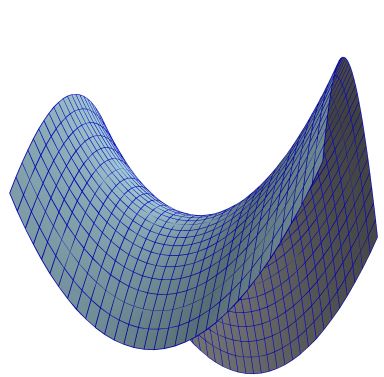
Hyperbolic paraboloid#
- User.HyperbolicParaboloid(a, Resolution)#
See also: https://mathworld.wolfram.com/HyperbolicParaboloid.html
 \(\quad\)
Left figure: Hyperbolic paraboloid (see also Wikipedia [1462], Gray et al. [368], Krivoshapko and Ivanov [421]).
Right figure: Hyperbolic paraboloid (see also Wikipedia [1444], Gray et al. [368], Krivoshapko and Ivanov [421]).
References
Gray, A. “The Hyperbolic Paraboloid.” Modern Differential Geometry of Curves and Surfaces with Mathematica, 2nd ed. Boca Raton, FL: CRC Press, pp. 297-298 and 449, 1997.
Array Surface, general#
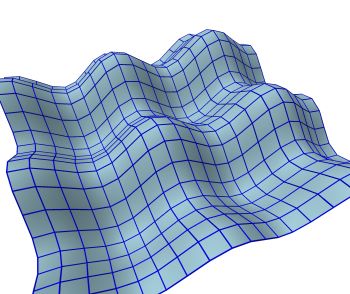
Left figure: parametric plot of Array Surface, general. Camera angles are \(\theta=135^\circ\) and \(\phi = -12^\circ\).
Fractal Landscape surface#
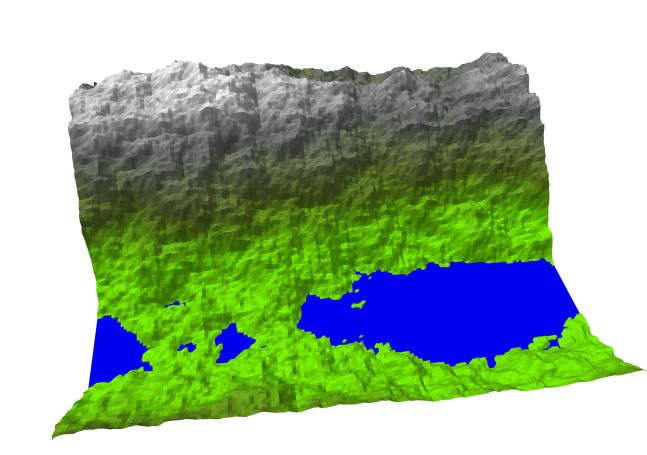
Left figure: parametric plot of Fractal Landscape surface. Camera angles are \(\theta=135^\circ\) and \(\phi = -12^\circ\).
Sombrero function#
See also: https://en.m.wikipedia.org/wiki/File:Sombrero_function_3d.png

See also: https://mathworld.wolfram.com/JincFunction.html
See also: https://en.wikipedia.org/wiki/Sombrero_function
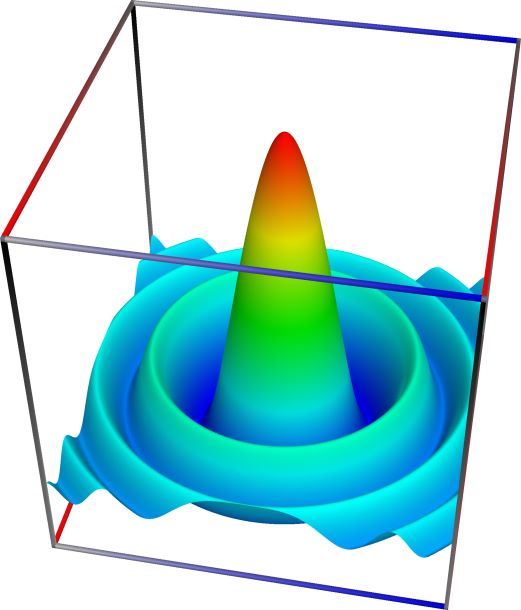
Left figure: real (“silver”) and imaginary (“gold”) part of the Sombrero function. Camera angles are \(\theta=135^\circ\) and \(\phi = -12^\circ\), camera radius is -2.
General 3D Wave function#
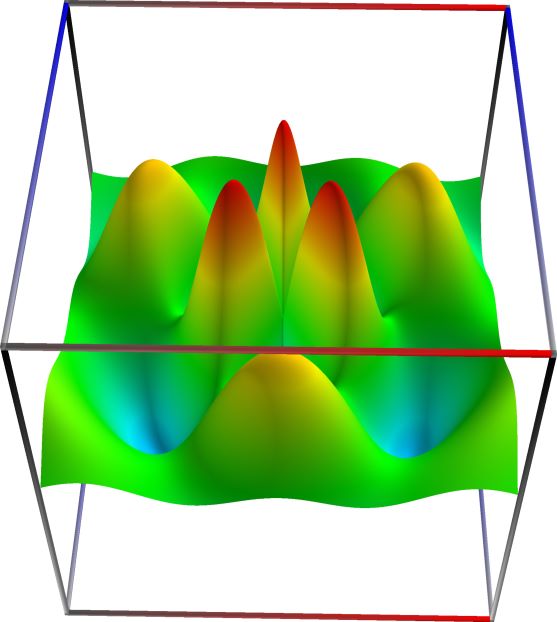
Left figure: real (“silver”) and imaginary (“gold”) part of the General 3D Wave function. Camera angles are \(\theta=135^\circ\) and \(\phi = -12^\circ\), camera radius is -2.
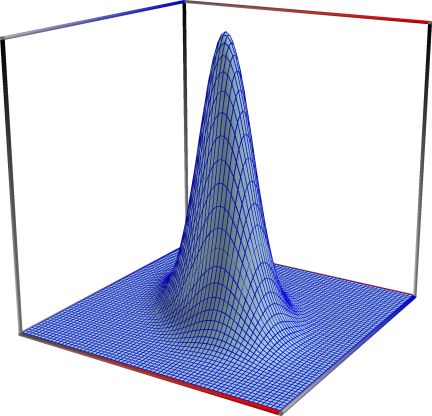
Bivariate normal function#
 \(\quad\)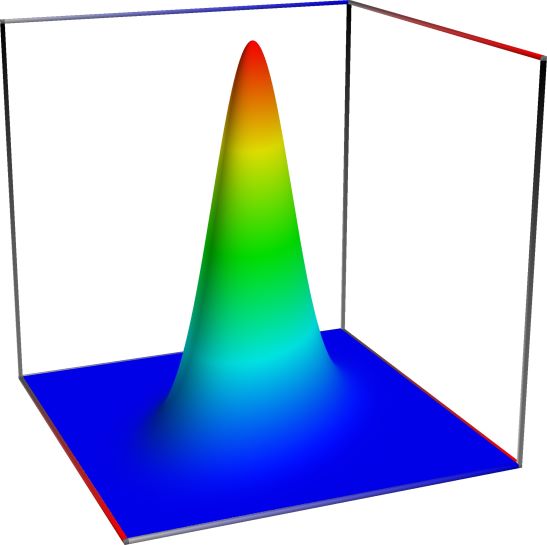
Left figure: absolute value of the of the bivariate normal distribution function, with color-coded phase. Camera angles are \(\theta=135^\circ\) and \(\phi = -12^\circ\), camera radius is -2.
Right figure: absolute value of the of the bivariate normal distribution function, with color-coded phase. Camera angles are \(\theta=135^\circ\) and \(\phi = -12^\circ\), camera radius is -2.